
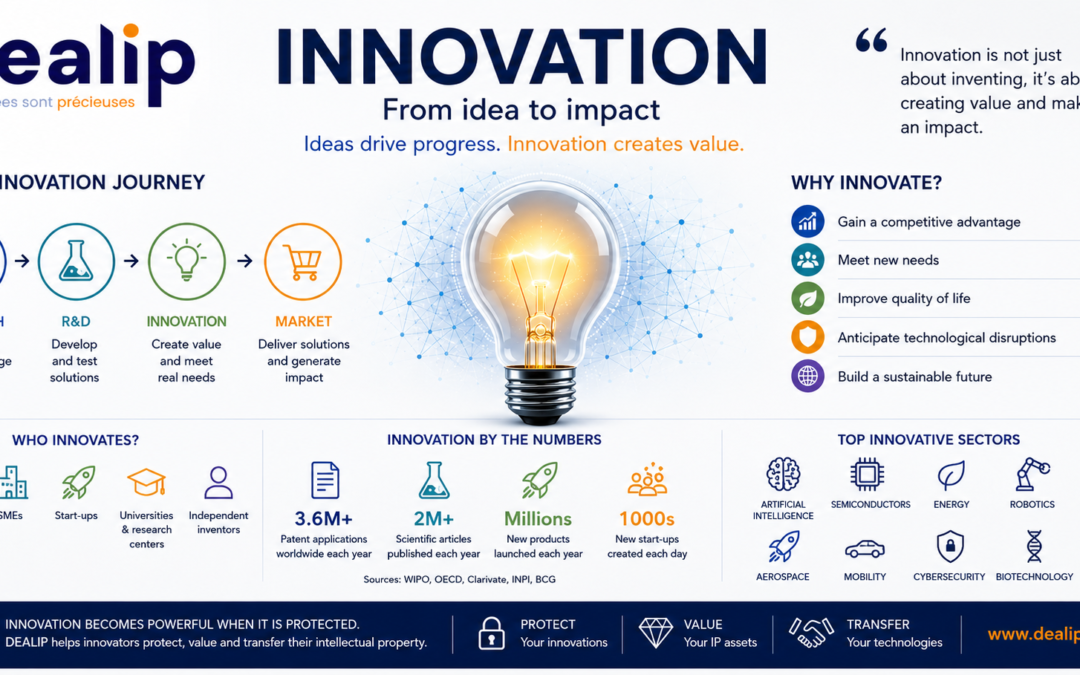
What is innovation? Why is it the driving force behind progress?
Innovation drives economic growth, corporate competitiveness, and improvements in our quality of life.**
However, the term is often misused to describe anything new. Is an invention the same as an innovation? Does research directly produce innovations? Who actually innovates? How many innovations are created worldwide each year?
This article answers these fundamental questions.
What is innovation?
Innovation consists of **transforming an idea into a value-creating solution**.
This value can be:
* economic,
* industrial,
* environmental,
* societal,
* or even strategic.
Innovation is therefore not limited to the mere invention of something new.
A brilliant idea that remains at the laboratory stage is not an innovation.
It only becomes an innovation when it is:
* developed,
* used,
* commercialized,
* or successfully implemented.
The OECD defines innovation as:
« The implementation of a new or significantly improved product, process, service, or organizational method. »
Invention vs. innovation: what is the difference?
Many people confuse these two concepts.
An invention is a new technical solution.
It generally addresses a technical problem.
It can be protected by a patent.
Examples:
* the transistor,
* the laser,
* the electric motor,
* a new type of battery,
* a novel algorithm.
An invention may never actually be used. —
An innovation is an invention that actually creates value.
Examples:
* the iPhone was not the first smartphone,
* Netflix did not invent video,
* Uber did not invent the taxi,
* Airbnb did not invent accommodation. These companies innovated by offering a new usage model.
Where does innovation fit into the development cycle?
Innovation occurs between scientific research and the market. This cycle can be represented as follows:
Basic research
↓
Applied research
↓
Development (R&D)
↓
Prototype
↓
Proof of concept
↓
Industrialization
↓
Innovation
↓
Commercialization
↓
Diffusion
« `
Each stage has different objectives.
Research aims to generate new knowledge.
It addresses questions such as:
* Why?
* How?
* What physical phenomena are involved?
It is primarily conducted by:
* universities,
* laboratories,
* public institutions.
Research and Development : R&D transforms knowledge into technical solutions.
It enables, among other things:
* designing a prototype,
* improving a technology,
* reducing costs,
* increasing product reliability.
R&D does not automatically lead to innovation.
Many R&D projects never reach the market.
Innovation
Innovation occurs when the solution genuinely meets a need.
It involves:
* user adoption,
* value creation,
* a measurable impact.
Why innovate?
Innovation serves several objectives.
Creating a competitive advantage
Innovative companies set themselves apart from their competitors. They can:
* offer superior performance,
* reduce costs,
* improve margins,
* build customer loyalty.
Meeting new needs
Expectations are constantly evolving.
Innovations make it possible to:
* improve comfort,
* enhance safety,
* reduce energy consumption,
* limit environmental impact.
Anticipating disruptive technologies
Innovation helps prepare for the future. Companies that fail to innovate often disappear in the face of more agile competitors.
Kodak, Nokia, and Blockbuster perfectly illustrate this phenomenon.
Who innovates?
Contrary to popular belief, innovation is not the exclusive domain of large companies.
It stems from a wide variety of players.
Large companies
They often possess:
* substantial R&D budgets,
* laboratories,
* patent portfolios,
* intellectual property strategies.
SMEs are often highly innovative thanks to their agility. They can rapidly develop:
* a new process,
* new software,
* new equipment.
Start-ups
Start-ups often seek disruptive innovation.
Their goal is to completely transform a market.
________________________________________
Laboratories
They produce the scientific discoveries that fuel future innovations.
________________________________________
Independent inventors
Many innovations come from individual inventors.
They file patents before:
• starting their company,
• selling their technology,
• licensing it out.
________________________________________
The four main categories of innovation
Product innovation
Creation of a new product.
Example:
• a new drone,
• a solid-state battery,
• a miniature sensor.
________________________________________
Process innovation
New manufacturing method.
Example:
• 3D printing,
• additive manufacturing,
• industrial automation.
________________________________________
Service innovation
New service.
Example:
• online banking,
• telemedicine,
• streaming.
________________________________________
Organizational innovation
New way of working.
Example:
• remote work,
• Industry 4.0,
• collaborative production.
________________________________________
Disruptive innovations
Some innovations completely transform a sector.
Historical examples:
• the Internet,
• GPS,
• artificial intelligence,
• the smartphone,
• 3D printing,
• CRISPR,
• electric vehicles.
These innovations often create new markets.
________________________________________
How many innovations worldwide?
It is impossible to count every innovation, as many are neither patented nor published.
Indicators are used instead.
Each year:
• approximately 3.6 to 3.8 million patent applications are filed worldwide;
• more than 2 million new scientific articles are published;
• tens of millions of new products are launched;
• hundreds of thousands of start-ups are created.
However, patents are only one indicator: some innovations are protected by trade secrets, while others are not patentable.
________________________________________
And in France? France ranks among the leading innovative nations.
Some key figures:
• approximately 15,000 to 16,000 French patent applications are filed annually with the INPI (National Institute of Industrial Property);
• nearly 90,000 applications are filed with the European Patent Office by entities worldwide, including several thousand from France;
• more than 200,000 researchers work in the public and private sectors;
• national R&D expenditure accounts for approximately 2.2% of GDP.
The most innovative sectors are:
• aerospace,
• space,
• healthcare,
• energy,
• digital technology,
• defense,
• artificial intelligence,
• microelectronics.
________________________________________
Can innovation be measured?
No single indicator is perfect.
Commonly used metrics include:
• number of patents;
• R&D expenditure;
• revenue generated by new products;
• scientific publications;
• technology licenses;
• fundraising;
• start-up creation.
A company can be highly innovative while filing very few patents.
Conversely, some companies hold extensive patent portfolios without generating economic value.
________________________________________
Intellectual property: an innovation accelerator
Innovation often entails years of investment.
Intellectual property helps protect this effort through:
• patents;
• trademarks;
• industrial designs;
• copyright;
• confidential know-how (trade secrets).
A well-structured intellectual property strategy facilitates:
• industrial partnerships;
• fundraising;
• licensing;
• technology transfers;
• leveraging intangible assets. ________________________________________
DEALIP: transforming innovation into value
At DEALIP, we believe that innovation holds value only when it is identified, protected, and leveraged.
Our mission is to support companies, inventors, and laboratories across every stage of the innovation value chain:
• innovation identification;
• patentability analysis;
• intellectual property strategy;
• patent portfolio valorization;
• industrial partner sourcing;
• licensing and technology transfer.
Because an idea only changes the world when it becomes an innovation that is useful, protected, and put to use.
Global innovation champions
Innovation is a key driver of competitiveness today. Some companies invest billions of euros annually in the research, development, and protection of their inventions.
They file thousands of patents, develop new technologies, and profoundly transform their markets. Major international rankings, such as the BCG Most Innovative Companies or the Clarivate Top 100 Global Innovators, consistently identify the same leaders. The World’s Most Innovative Companies
Company Sector Areas of Innovation
Apple Electronics Smartphones, AI, connected devices
Alphabet (Google) Digital Artificial intelligence, cloud computing, quantum computing
Microsoft Software Generative AI, cloud computing, cybersecurity
Amazon Commerce and cloud computing Robotics, logistics, artificial intelligence
NVIDIA Semiconductors Graphics processors, AI
Samsung Electronics Electronics Semiconductors, displays, telecommunications
Huawei Telecommunications 5G/6G networks, artificial intelligence
Toyota Automotive Hybrid powertrains, hydrogen
Tesla Automotive Electric vehicles, batteries, embedded software
Siemens Industry Automation, Industry 4.0, industrial digitalization
These companies each invest between €10 billion and over €30 billion annually in research and development and file several thousand patents each year. ________________________________________
France’s Most Innovative Companies
France boasts a globally recognized innovation ecosystem, particularly in aerospace, defense, energy, transportation, healthcare, and semiconductors.
Among the most innovative companies are:
Company | Main areas of innovation
Airbus: Decarbonized aviation, space, advanced materials
Thales: Defense, radar, cybersecurity, artificial intelligence
Safran: Aircraft engines, propulsion, materials
Dassault Systèmes: Digital twins, simulation, digital industry
Schneider Electric: Smart grids, energy management
STMicroelectronics: Semiconductors, power electronics
Michelin: New materials, sustainable mobility
Valeo: Driver assistance, autonomous vehicles
FORVIA: Smart mobility, automotive electronics
Sanofi: Biotechnology, vaccines, innovative medicines
L’Oréal: Cosmetics, biotechnology, artificial intelligence
Orange: Telecommunications, cybersecurity
EDF: Nuclear energy, smart grids
In addition to these companies, several major French research organizations such as the CEA, CNRS, ONERA, and INRIA play a crucial role in developing tomorrow’s technologies before their transfer to industry. ________________________________________
Which sectors are the most innovative?
Today, global innovation is primarily driven by a few major technological fields:
• Artificial intelligence;
• Microelectronics and semiconductors;
• Cybersecurity;
• Quantum computing;
• Aerospace;
• Defense;
• Biotechnology and healthcare;
• Robotics;
• Decarbonized energy;
• Electric and autonomous vehicles;
• Telecommunications (5G and preparation for 6G);
• Industry 4.0 and smart manufacturing.
These sectors account for a significant share of global R&D investment and patent filings.
____________________________________________ R&D investment: an indicator of innovation
Innovation requires substantial investment. Globally, research and development spending now exceeds €2.5 trillion per year, representing nearly 2.5% of global GDP.
The most innovative companies often dedicate 10 to 20% of their revenue to R&D. In the semiconductor, biotechnology, and artificial intelligence sectors, this rate can exceed 25%.
In France, R&D spending represents approximately 2.2% of GDP, or nearly €65 billion annually, distributed among businesses, universities, and public research organizations.
Innovation also relies on intellectual property.
The most innovative companies do not simply develop new technologies; they protect them. Patents, trademarks, designs, software, and trade secrets constitute strategic assets that secure investments in research and development.
Intellectual property also fosters industrial partnerships, technology transfers, licensing agreements, and fundraising. A protected innovation is more easily commercialized and constitutes a sustainable competitive advantage.
Your content goes here. Edit or remove this text inline or in the module Content settings. You can also style every aspect of this content in the module Design settings and even apply custom CSS to this text in the module Advanced settings.